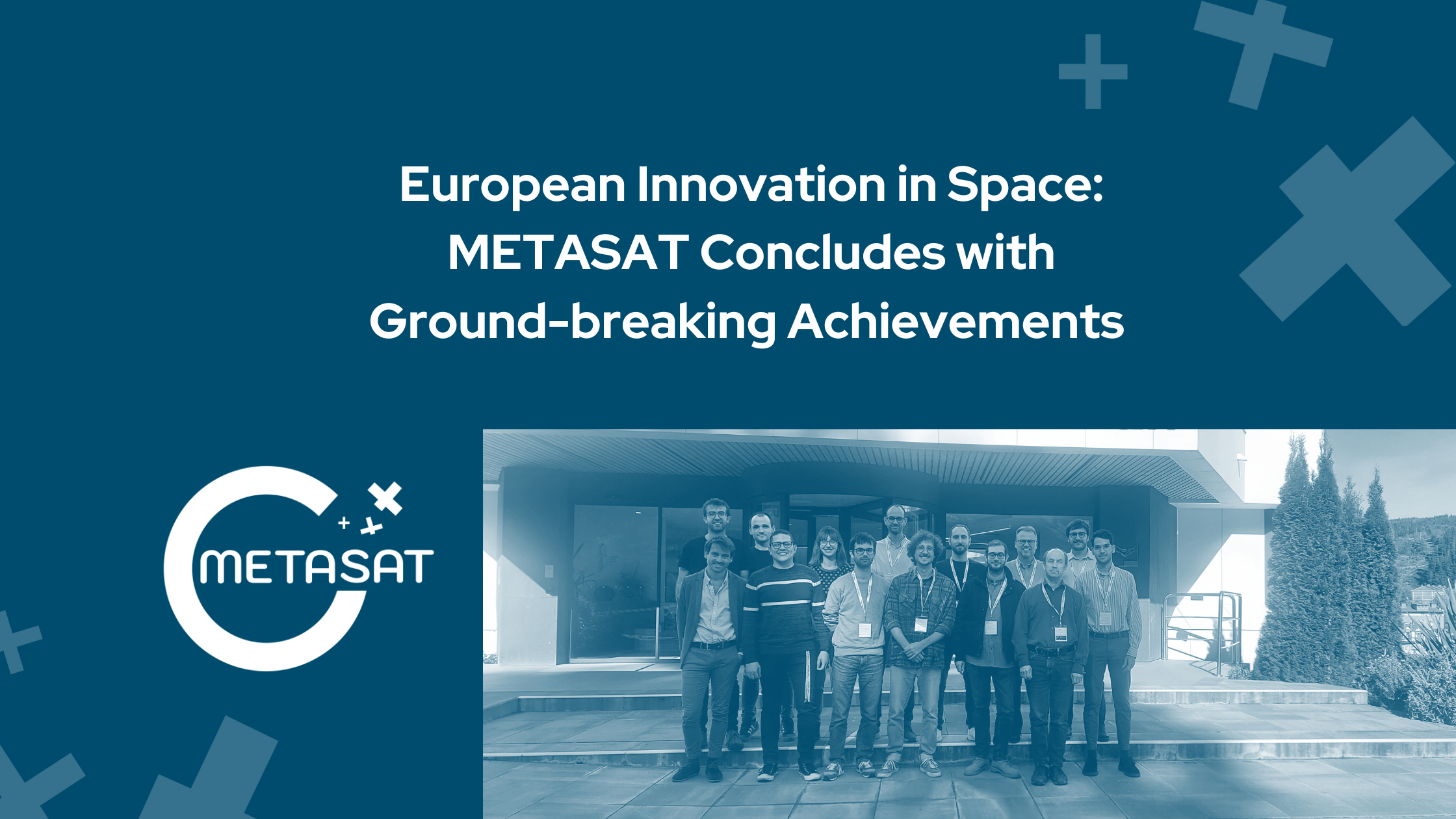
The METASAT project, the European initiative to advance the development of high-performance space systems, will come to its official conclusion at the end of the year. This promising project combined the experience of knowledge generators like Barcelona Supercomputing Center, Ikerlan, and Collins Aerospace Applied Research & Technology Italy (ALES Srl) with technology integrators such as FENTISS and OHB, one of the main European end users from the space sector. Over its course, METASAT has redefined how space technologies are designed and validated, delivering innovative hardware, software, and engineering methodologies that promise to set new benchmarks for efficiency, reliability, and cost-effectiveness in the aerospace sector.
A New Era of Satellite Design: Model-Based Engineering and Digital Twins
At its core, METASAT embraced a cutting-edge Model-Based Engineering (MBE) virtual integration methodology based on interoperability standards (FMI 2.0, SystemC TLM 2.0, ED-247), reshaping traditional development approaches. By leveraging modelling and simulation-based system-level analysis, the project enabled early design validation and seamless integration of complex hardware and software components. Central to this approach was the introduction of digital twins, virtual replicas of physical systems that allowed mission-critical functionalities to be tested and refined in a risk-free virtual environment. This innovation not only accelerated development timelines but also reduced costs while enhancing reliability.
Advanced Hardware and Software Innovations for Space
The project’s technological breakthroughs extended to hardware, delivering a state-of-the-art platform built on RISC-V multicore processors (NOEL-V) and augmented with advanced AI accelerators (SPARROW) and GPUs (VORTEX). Designed to meet the demanding requirements of modern space missions, this high-performance architecture excels in computational tasks such as machine learning and real-time data processing. The platform was realized through FPGA prototypes, equipped with versatile peripherals including Ethernet communication and other generic I/O, making it adaptable to a diverse range of mission needs.
On the software side, METASAT introduced a powerful and flexible software ecosystem. The XtratuM/NextGeneration (XNG) hypervisor played a central role, enabling the efficient management of critical and non-critical applications on a single platform. The software ecosystem also featured enhanced support for real-time operating systems (RTOS), compilers, and open standards like OpenGL SC 2.0, ensuring compatibility with industry requirements. Additionally, TensorFlow Micro support was integrated to power AI-driven applications, reinforcing the project’s commitment to leveraging data-driven technologies for space exploration.
Paving the Way for Future Space Innovations
METASAT’s innovations were tested in real-world applications, demonstrating their transformative potential. From machine learning algorithms for Earth observation, such as cloud detection and ship tracking, to real on-board satellite instrument control software extended by a novel approach of protection against system failures, the project showcased its ability to solve complex challenges. Moreover, METASAT successfully integrated various temperature data from the EnMAP satellite instrument in space into a fully operational telemetry and ground station-like communication system, illustrating its end-to-end capabilities.
As METASAT draws to a close, its impact will resonate far beyond the project’s lifecycle. By introducing transformative engineering methodologies, advanced hardware, and versatile software solutions, METASAT has laid the foundation for faster, more reliable, and cost-effective space system development. This legacy solidifies Europe’s leadership in aerospace innovation and ensures that the advancements made during METASAT will continue to propel future missions to new heights.